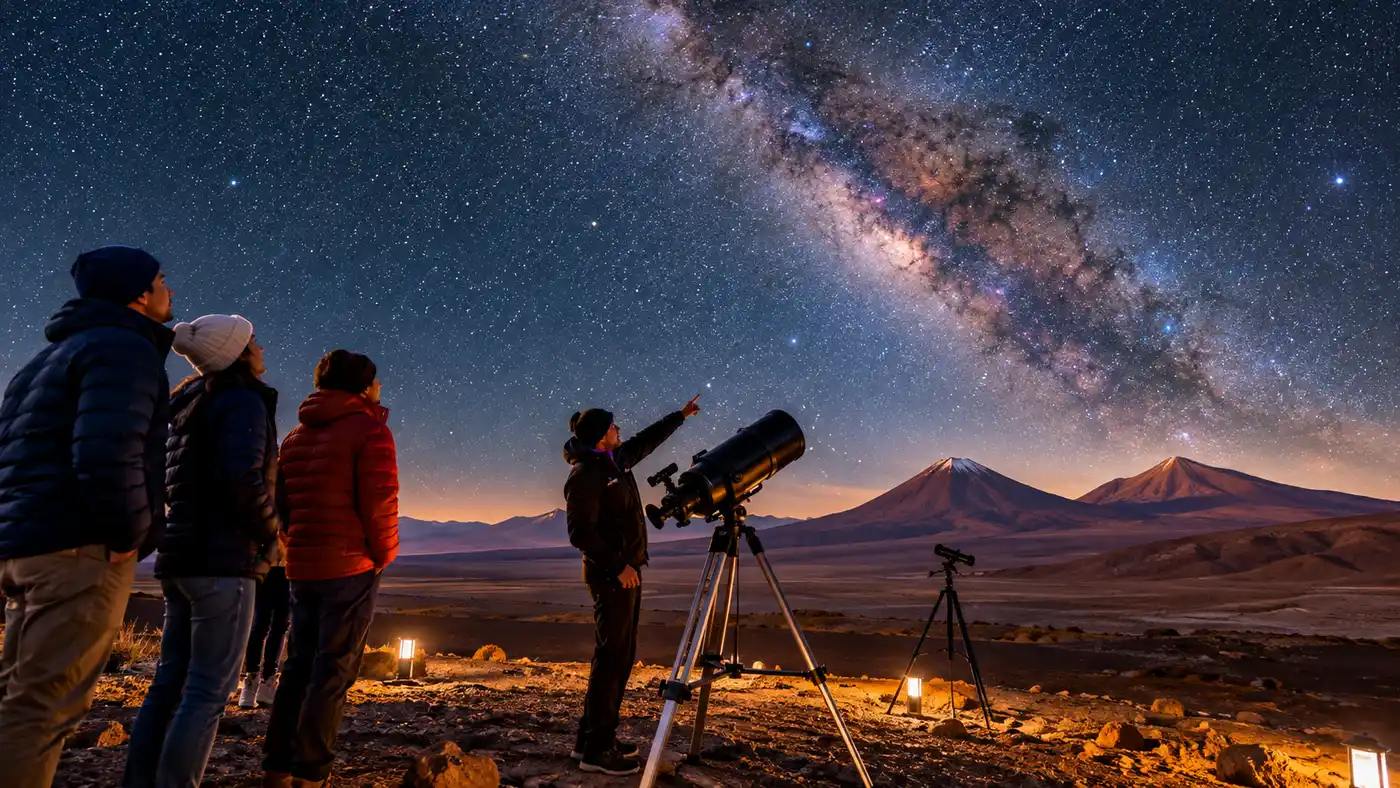
San Pedro de Atacama Stargazing & Astronomical Tours
Step outside San Pedro de Atacama around ten at night, walk past the last mud-brick wall where the streetlights end, and look up. The sky looks fake. You can see the fuzzy glowing smudge of the Large Magellanic Cloud without squinting, and the Milky Way has enough texture to cast faint shadows on the gravel. Booking a san pedro de atacama stargazing tour is something almost every traveler plans to do here, and for good reason. You are standing under what astronomers consider the clearest patch of atmosphere on planet Earth.
Between the extreme altitude, the bone-dry air, and the sheer emptiness of northern Chile, the conditions are practically unmatched. Hundreds of scientists live out here running multi-billion-dollar international telescope arrays on distant plateaus. But you do not need a degree in astrophysics to appreciate it. Local guides run nightly excursions into the desert scrub, combining high-end consumer telescopes with indigenous folklore, astrophotography, and mugs of spiked hot chocolate. Still, these outings are not all created equal, and booking the wrong night or the wrong operator can leave you shivering in a dirt field staring at a washed-out moon.
Why the Night Sky Here Looks Different
Most people know the Atacama is dry, but they do not realize what that actually does to starlight. Moisture in the air refracts and scatters light before it reaches your eye. In humid places, stars twinkle furiously because their light is passing through shifting pockets of water vapor. Out here, 2,400 meters above sea level in the world's driest non-polar desert, the air contains almost zero humidity. The stars do not twinkle much. They burn as steady, needle-sharp pinpricks.
You also get a front-row seat to the Southern Hemisphere. If you grew up north of the equator, your brain expects the Big Dipper or Polaris. Forget those. Down here, the night is dominated by the Southern Cross, the brilliant glow of Alpha Centauri, and the Carina Nebula. Most striking of all are the dark constellations. Centuries before Europeans arrived with brass instruments, the local Lickanantay and Quechua people looked at the Milky Way not as a cluster of bright stars, but as an ink-black river. They found patterns in the interstellar dust clouds that block the background light, tracing the shapes of a celestial llama, a baby llama, a toad, and a serpent.
Note: High-altitude observatories like ALMA or the VLT at Cerro Paranal are strictly research facilities and do not allow the public on evening stargazing sessions. Night tourist tours all run from private desert plots outside town.
There is also the sheer lack of people. San Pedro is a tiny town surrounded by thousands of square kilometers of unpopulated, salt-crusted plain. Drive fifteen minutes past the town perimeter and light pollution drops to virtually zero. It takes about twenty minutes for your pupils to expand completely. Once they do, the sheer volume of visible stars can make you slightly dizzy.
Book your atacama desert tours experience:
Choosing Your Astronomical Tour San Pedro de Atacama Style
Walk down Calle Caracoles in the afternoon and you will see dozens of chalkboard signs advertising an astronomical tour san pedro de atacama visitors can join that evening. Sorting through them can be exhausting. Broadly speaking, the tours fall into three distinct camps: deep-space telescope viewings, cultural ethno-astronomy sessions, and specialized astrophotography nights.
Classic telescope tours are the most common. A mini-van picks you up around 9:00 PM, drives 15 kilometers into the desert, and drops you at an outdoor base equipped with three or four Dobsonian telescopes. A guide spends the first half-hour sweeping an absurdly powerful green laser pointer across the constellations, pointing out planetary nebulae, globular clusters, and visible planets like Jupiter or Saturn. Afterward, everyone takes turns queuing up at the eyepieces to view deep-sky targets. These groups range from 8 to 20 people.
Cultural tours focus heavily on Andean cosmovision. Instead of geeking out over light years and stellar lifespans, the guide explains how ancient agricultural societies used the rising and setting of specific dust lanes to time their potato planting and llama breeding. These sessions often take place around an outdoor fire pit with local herbal tea like muña or rica-rica. They feel intimate and grounded, though you might spend less time squinting through giant lenses.
| Tour Type | Average Cost | Group Size | Main Focus |
|---|---|---|---|
| Classic Telescope | $35 - $50 USD | 12 - 20 guests | Deep-sky objects, planets, laser guide |
| Andean Ethno-Astronomy | $40 - $60 USD | 8 - 12 guests | Indigenous lore, dark constellations, culture |
| Astrophotography Night | $60 - $95 USD | 4 - 8 guests | DSLR techniques, long exposures, portrait photos |
| Private Observatory | $120 - $220 USD | 1 - 4 guests | Large aperture domes, custom viewing targets |
If getting a great photo for yourself matters, consider the astrophotography angle. Cell phones simply cannot capture the desert night without turning the sky into green digital noise. Many standard tours now include a quick group portrait under the stars taken by the guide with a DSLR, but an actual dedicated photo tour gives you tripod time and advice on camera settings.
How to Find the Best Astronomy Tour San Pedro de Atacama Has Right Now
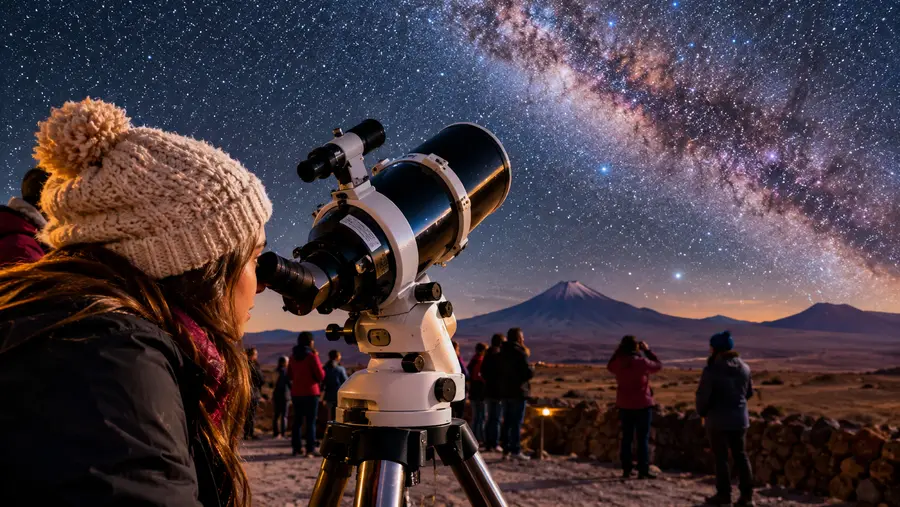
Finding the best astronomy tour san pedro de atacama has on offer really comes down to group size and guide fluency. Because the town runs heavily on tourism, some agencies cut corners by outsourcing their stargazing slots to crowded open-air yards where forty people wait in line behind a single 8-inch mirror. You spend half the evening tapping your feet in freezing gravel waiting for someone to finish staring at Saturn.
When booking, walk in and ask specific questions. Good operators are proud of their gear and their guides:
- Telescope size: Look for outfits using mirrors that are 12 to 16 inches wide, which pull in dramatically more light than entry-level scopes.
- Maximum group size: Aim for outings capped at 12 to 15 people so you get meaningful eyepiece time.
- Language split: Make sure English and Spanish speakers are separated into different groups or have dedicated guides, otherwise every explanation gets repeated twice while you get cold.
- Transport details: Verify whether hotel pickup and drop-off are included, as walking back across town on unlit dirt roads at 1:00 AM is nobody's idea of fun.
If you are piecing together multiple excursions across your trip, checking our San Pedro de Atacama tour operators and agencies guide can save you from the low-effort street hawkers. You will find that smaller independent astronomy outfits usually deliver a much better night than general agencies that sell everything from sandboarding to geysers.
Book your atacama desert tours experience:
The Moon Cycle: Why Timing Is Everything
Nobody wants to hear this after booking non-refundable flights, but the moon is the natural enemy of deep-sky stargazing. When the moon is full, it reflects so much sunlight off the desert floor that the sky turns pale navy blue. The Milky Way essentially disappears. You will still see bright planets and the moon itself looks astonishing through a telescope - you can see shadows cast inside impact craters - but the faint nebulae and distant galaxies simply vanish.
Pro tip: Plan your trip around the lunar calendar if astronomy is your priority. The five days before and after a new moon offer pitch-black skies and the most dramatic Milky Way views.
Many travelers find themselves in town during a full moon anyway. Do not panic. A moonlit desert is eerie and gorgeous in its own way, and agencies adjust their programming. Instead of hunting faint star clusters, a good star tour san pedro de atacama guide will pivot toward high-magnification views of lunar topography, double stars, and bright planetary discs. Some agencies close for three to four nights right around the peak full moon, so check dates ahead of time.
Weather is rarely an issue, though there is one major exception. Between late January and early March, the so-called Bolivian Winter brings moisture over the Andes, causing unexpected cloud cover and afternoon thunderstorms. If you want consistently clear skies, cross-check our guide on the best time to visit the Atacama Desert before locking in your travel window.
What Actually Happens on a Tour Astronomico San Pedro de Atacama
Expect to leave town around 8:45 PM or 9:30 PM, depending on the season. The van winds out into the darkness, past the ayllus - the ancient agricultural oasis hamlets surrounding San Pedro. The headlights shut off. For the first two minutes, you cannot see your own shoes.
Your guide gathers everyone together and lays out the ground rules: no white flashlights, no phone screens, and watch where you step. It takes your retinas a while to adapt. While your eyes adjust, the guide begins the laser sky tour. High-powered green lasers slice right through the atmosphere, appearing to touch the stars themselves. You will learn how to locate the south celestial pole using the Southern Cross and the Pointer stars, a navigational trick used by sailors for centuries.
Cold hits quickly out here. Even in the middle of summer, desert temperatures tumble the moment the sun drops behind the Cordillera de la Sal. In July or August, it routinely dips below freezing by 10:30 PM. Standing still on cold ground listening to an astronomy lecture draws heat out of your boots remarkably fast.
- Thick windproof outer layer: A heavy down jacket or windbreaker keeps the persistent night breeze from cutting through your clothes.
- Warm headwear and gloves: Thin gloves allow you to adjust your camera or hold a warm mug without exposing your bare skin to sub-zero desert air.
- Flat, sturdy boots: Telescope yards are unpaved, dusty, and full of rocks you cannot see in the dark.
- Thermal base layers: Long underwear makes a two-hour open-air star tour comfortable rather than an endurance test.
Toward the end of the session, most operators invite everyone inside an adobe shelter or around an open-air table. They serve hot tea, coffee, wine, and biscuits while answering questions. People end up asking about black holes, alien life, and what it is like living in the driest desert in the world. It feels casual and warm. By midnight, you are back at your hotel door, rubbing your eyes and trying to process the scale of what you just looked at.
Looking for a San Pedro de Atacama Observatory Tour?
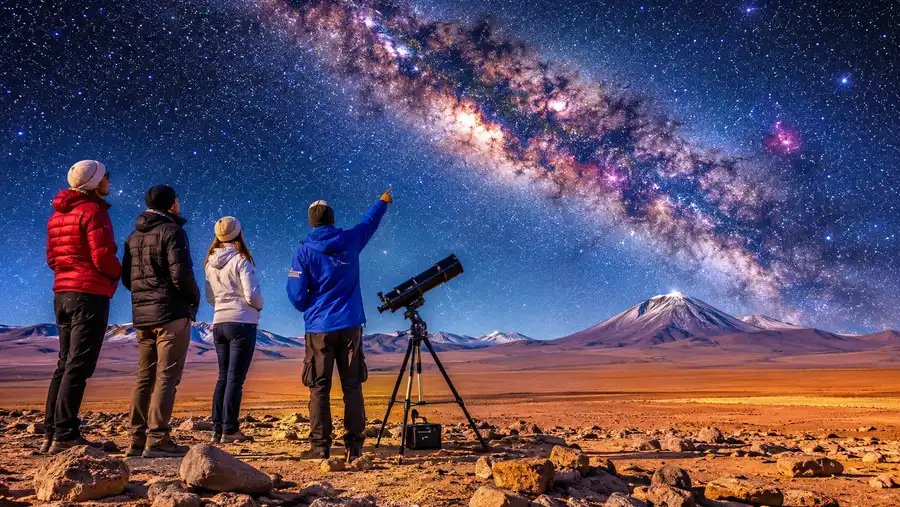
Travelers often confuse an evening desert sky tour with an official san pedro de atacama observatory tour. If your goal is to visit world-class professional telescopes, you need to manage expectations. ALMA (the Atacama Large Millimeter/submillimeter Array) sits up on the Chajnantor plateau at 5,000 meters. The public cannot go to the high plateau at night because of severe hypoxia risks. However, ALMA does offer free, pre-booked weekend morning tours of their base support facility at 2,900 meters, where engineers maintain the dishes and run the control rooms.
For actual nighttime observatory visits with permanent dome structures open to the public, look into smaller private establishments like the SPACE observatory (San Pedro de Atacama Celestial Explorations) run by dedicated amateur astronomers, or the facilities near the village of Solor. These setups use tracking domes and larger-aperture optics than the portable setups used by street-corner tour vans. They cost roughly $50 to $70 USD per person and book out weeks in advance.
Either way, the experience leaves a mark. Watching the dust lanes of our own galaxy stretch from horizon to horizon changes the way you think about a clear night. You will go home, look up at your backyard sky, and wonder where all the stars went.
Frequently Asked Questions about san pedro de atacama stargazing tour
What time of year is best for stargazing in San Pedro?
The winter months from May to September offer the crispest, driest air and the clearest skies, though night temperatures frequently drop below freezing. Avoid late January and February if possible, as the Bolivian Winter brings occasional clouds and rain.
Can I do an astronomy tour during a full moon?
Yes, but the experience will focus on the moon itself, bright planets, and double stars. The Milky Way and deep-sky nebulae are washed out by moonlight. Some agencies close for three to four days around the peak full moon.
How cold does it actually get during the tour?
In winter (June through August), temperatures easily dip between -5°C and 2°C (23°F to 35°F) out in the open desert. In summer, expect temperatures around 8°C to 12°C (46°F to 54°F). Dress far warmer than you think is necessary.
Can I take great photos of the stars with my smartphone?
Modern phones with dedicated night modes can capture decent wide-angle images on a tripod, but they struggle with fine detail. Most top-rated tours now include a professional digital photo of you under the night sky taken by the guide.
Quick Reference
- Elevation: 2,400 meters above sea level
- Typical tour duration: 2 to 2.5 hours
- Average night temperature: -3°C to 10°C
- Best lunar window: 5 days around the new moon
Book your atacama desert tours experience:
The Bottom Line
You can skip a lot of tourist excursions in northern Chile without missing the soul of the region, but skipping the night sky would be a mistake. Book your tour for early in your trip so that if clouds roll through, you have another night or two to reschedule. Pack your warmest jacket, leave your phone in your pocket, and spend a couple of hours letting the southern sky remind you just how small we really are.
Read more about atacama desert tours.