Atacama Desert Travel Guide: Essential Visitor Information
My lips split open on day two, right around noon, while I was staring at a crust of dried salt that stretched forty miles toward a row of dormant volcanoes. Nobody warns you enough about the air. It pulls every drop of moisture out of your pores the second you step off the plane in Calama, leaving your throat scratchy and your water bottle permanently half-empty. If you plan to visit atacama desert landscapes anytime soon, you need to understand that this corner of northern Chile does not bend to your comfort. You adapt to it, drink four liters of tap water a day, buy cocoa leaves from the tiny grocer behind the plaza, and let the strange, mineral beauty of the place wash the fatigue right out of your skull.
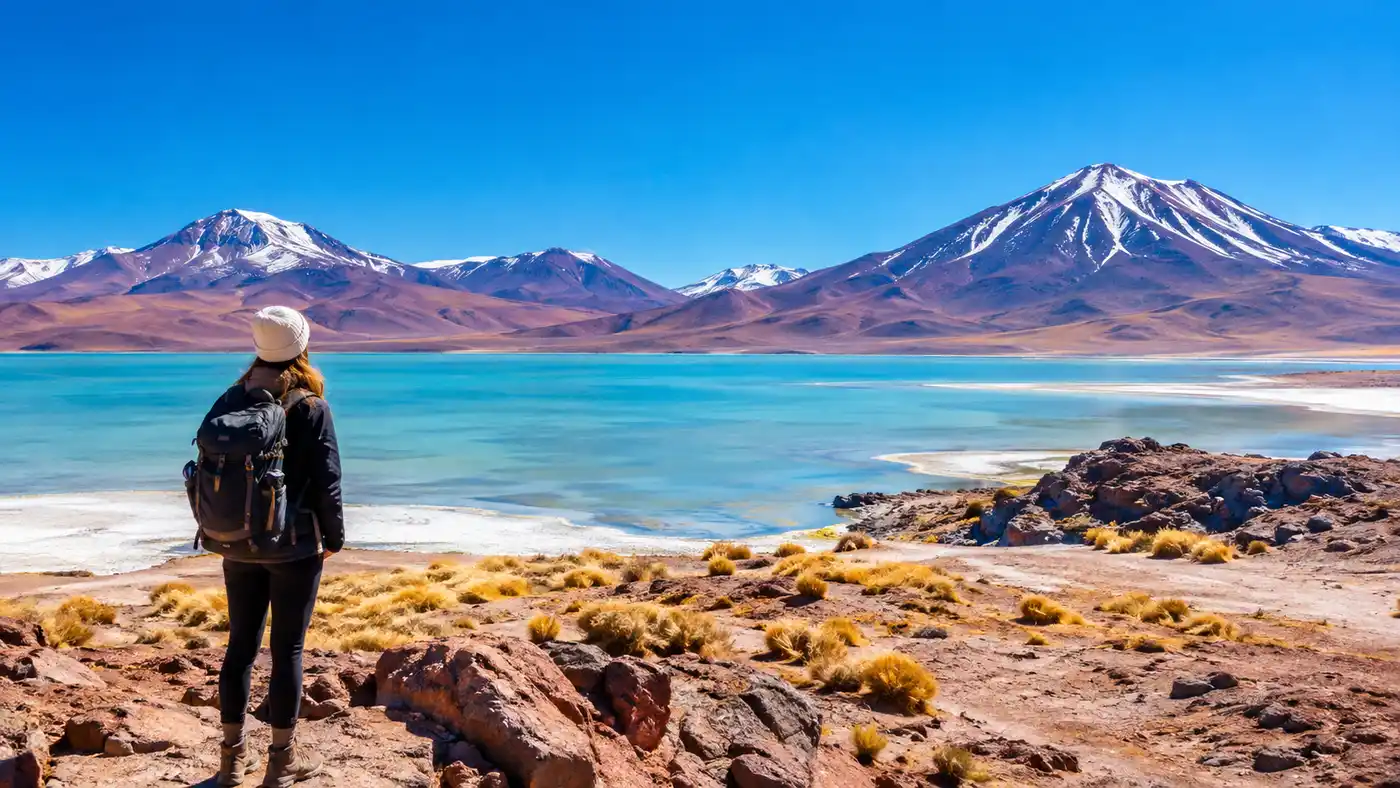
Most travelers imagine a sweeping sandbox when they think of deserts. Chile's Atacama is nothing like that. It sits on a high volcanic plateau between the Pacific coast and the Andes, looking more like southern Utah collided with Mars and got bleached by UV radiation. You get geysers spewing sulfur steam at 14,000 feet, blinding white salt pans ringed by pink flamingos, and an oasis town built entirely of sun-baked adobe bricks where dust coats everything from your rental car windshield to your evening glass of carménère.
Book your atacama desert tours experience:
Understanding the Atacama Location and Lay of the Land
Look at an Atacama on world map view and you will spot a thin sliver hugging South America's western spine. The desert covers roughly 41,000 square miles across the Antofagasta region and neighboring provinces, tucked neatly into the rain shadow between the Chilean Coastal Range and the towering Andes cordillera. That geographic trap prevents clouds from dumping rain on the soil. Some weather stations here have never recorded a single drop of rainfall in recorded history.
Your base camp for almost every excursion is San Pedro de Atacama Antofagasta Chile. It is an old indigenous oasis settlement located at 2,400 meters (about 7,900 feet) above sea level. You cannot easily base yourself anywhere else without spending five hours a day driving across gravel washboards. The town itself feels caught between worlds. Dirt alleys and centuries-old mud walls sit alongside solar-powered cafes and gear shops renting sandboards.
If you zoom into a desert Atacama map, you will realize how deceptively spread out everything is. The Valle de la Luna sits just 13 kilometers outside town, an easy afternoon cycle if your legs can handle the heat. But the El Tatio geyser field sits nearly 90 kilometers north, climbing past 4,300 meters into bone-chilling alpine tundra. Plan your days by elevation rather than just road distance. Rushing from the low valleys straight up into the altiplano on your first morning will leave you flat on your back in a dark hotel room nursing an altitude migraine.
Note: Fuel stations are practically nonexistent outside San Pedro and Calama. If you rent a car to explore the backroads toward Paso Sico, fill up completely every single time your tank drops below half.
How to Organize Your Days: Self-Drive vs Tours
Getting your bearings takes a minute. The town center is strictly pedestrian on its main corridors, Calle Caracoles and Calle Gustavo Le Paige. Walking down Caracoles at 6:00 PM feels like walking through an outdoor gear market. Touts hold laminated clipboards displaying photos of turquoise lagoons, while tourists in puff jackets compare notes on camera lenses. You can read our detailed guide on how to get to the Atacama Desert if you are still figuring out the flight connections from Santiago to Calama airport.
Renting a pickup truck gives you absolute freedom to arrive at the salt lagoons before the tour buses rumble in. The drive out to Laguna Chaxa at sunrise, when the water mirrors the pink dawn sky and wild flamingos step through the brine, is profoundly quiet when you are the only human within three miles. But driving on high-altitude gravel roads brings real risks. Washboards chew through cheap tires, GPS can fail unpredictably in deep canyons, and getting stuck at 13,000 feet with no cell reception is dangerous.
Joining organized day trips removes the logistics headache entirely. Local guides know the community ticket systems, which change constantly because indigenous atacameño communities manage their own ancestral lands. If you prefer curated excursions, spending a few hours comparing outfits in town helps you avoid the party vans packed with twenty noisy teenagers.
| Destination | Elevation | Drive Time from Town | Key Highlight |
|---|---|---|---|
| Valle de la Luna | 2,500 m | 18 minutes | Sandstone dunes, salt caverns, sunset viewpoints |
| Laguna Chaxa (Salar de Atacama) | 2,300 m | 55 minutes | Wild Andean and James flamingos feeding in salt pools |
| Piedras Rojas & Altiplanic Lagoons | 4,200 m | 1 hour 45 minutes | Rust-red volcanic rocks framing cobalt alpine water |
| El Tatio Geysers | 4,320 m | 1 hour 30 minutes | Dozens of steaming fumaroles erupting at freezing dawn |
| Termas de Puritama | 3,470 m | 40 minutes | Eight stepped thermal pools in a narrow mountain canyon |
Planning When to Visit Atacama Desert and Managing Weather
People assume a desert is hot all the time. That assumption ruins vacations here. Atacama desert travel requires an absurd wardrobe because the temperature swing between midday and midnight often exceeds 25 degrees Celsius. In the southern hemisphere winter (June to August), daytime temperatures sit around a perfect 20°C (68°F), but the thermometer plunges well below freezing the second the sun slips behind the Cordillera de la Sal.
Summer brings its own quirks. From late January through February, a weather pattern called the Bolivian Winter brings unusual moisture over the Andes. Heavy afternoon clouds roll in, dry riverbeds suddenly churn with brown mud, and park rangers frequently close access roads to El Tatio or Valle del Arcoiris for safety. I love November and March. The skies are crystal clear, prices drop slightly compared to the Christmas rush, and the biting winter wind has not arrived yet.
The night sky here is legendary for a reason. Because the air is bone-dry and there is virtually zero light pollution across hundreds of square miles, San Pedro cl has turned into the astronomical capital of South America. Book your nights around the lunar calendar. Strolling through the desert under a full moon is magical, but you will not see the sprawling arms of the Milky Way when the moon blazes like a streetlamp. If stargazing is your priority, reserve a spot with an astronomer during the new moon phase through a specialized agency like the ones featured in our overview of San Pedro de Atacama stargazing tours.
Pro tip: Schedule your stargazing tour for your first clear night in town. If wind or high clouds cancel it, you still have two or three backup evenings to reschedule before flying home.
Book your atacama desert tours experience:
High Altitude Tactics and Packing Smart
I felt fine on my first afternoon in San Pedro chile. That false confidence tricked me into jogging up a sand dune behind town, and two minutes later my lungs were burning like fire. San Pedro sits high enough to make you winded, but the real test comes when you push upward toward the high lagoons or the thermal springs.
Spend your first 48 hours below 3,000 meters. Explore the village church built from cactus wood, visit the Cejar Lagoon where you float like a cork in hypersaline water, or explore the strange clay towers of Valle de la Muerte. Save the 4,000-meter climbs for day three or four. Drink herbal tea brewed from chachacoma or rica-rica, two aromatic scrub bushes that grow wild on the hillsides. The locals swear chachacoma cures altitude sickness, and honestly, hot herbal tea settles a nervous stomach better than aspirin anyway.
- Eye protection: Category 3 or 4 UV-blocking sunglasses, because the glare reflecting off the white salt flats is intensely blinding.
- Hydration packet supplements: Electrolyte powders to mix into your water bottle every morning to combat constant dehydration headaches.
- Heavy windbreaker: A rugged outer shell with a fleece liner, essential for pre-dawn tours at El Tatio where winds cut right through knit sweaters.
- Nasal saline spray: A simple bottle of saline mist to prevent bloody noses caused by sleeping in zero-humidity air.
- Sturdy trail shoes: Shoes with stiff soles, since walking on the crunchy, razor-sharp crust of the salt flats will destroy thin sneakers.
Do not underestimate the sun. The solar radiation here is among the highest measured on earth. Slather on sunscreen with SPF 50 every two hours, even when the air feels chilly. A wide-brim hat is not a fashion choice in the atacama wüste chile; it is essential safety gear.
Costs, Money, and Practical Realities
San Pedro de Atacama Antofagasta region Chile is significantly more expensive than Santiago or Valparaíso. Everything you eat, drink, or sleep on has to be trucked in through the desert from hundreds of kilometers away. A casual lunch at an adobe restaurant on Calle Toconao costs around $18 to $25 per person, while a decent three-course dinner with local wine runs closer to $45. Budget travelers can survive on empanadas from the local bakeries near the municipal football field, where giant pastries stuffed with beef and olives cost about $4.
Cash is still king for national park entry fees. While tour agencies and nice hotels accept international credit cards, indigenous ticket booths at the park entrances often lack internet connectivity. If you arrive at Piedras Rojas with only a Visa card, the ranger will politely turn you around. Keep at least 60,000 Chilean pesos in mixed paper bills inside your daypack at all times.
- ATM reliability: There are only four ATMs in town, and they regularly run completely dry on long holiday weekends.
- Tipping norms: A 10 percent tip is standard and usually included as a voluntary line item on restaurant checks.
- Water safety: Tap water in San Pedro is heavily mineralized and loaded with natural boron; stick to bottled or filtered water for drinking.
- Electrical plugs: Outlets use standard Chilean Type C and L plugs at 220 volts, requiring an adapter for North American flat-prong cords.
WiFi in the oasis is notoriously spotty. Starlink has improved things for high-end boutique hotels, but budget hostels frequently lose internet during windstorms. Pick up an inexpensive Chilean prepaid eSIM card (Entel or Movistar) at the airport in Santiago before boarding your domestic connection to Calama. Entel offers the most reliable coverage across the open desert highways.
Frequently Asked Questions about visit atacama desert
How many days do you need to properly visit atacama desert?
Four full days is the sweet spot. That gives you two days to adjust to the 2,400-meter baseline while visiting low-elevation salt flats and Moon Valley, followed by two days to tackle high-altitude destinations like the El Tatio geysers and Altiplanic lagoons without getting sick.
Is San Pedro de Atacama safe for solo travelers?
It is remarkably safe. Violent crime is virtually unheard of in town. The main risks are environmental: dehydration, extreme sun exposure, freezing night temperatures, and getting lost if you decide to hike alone in the desert canyons without offline maps.
Can you visit Atacama and the Uyuni Salt Flats on the same trip?
Yes, and it is one of the most popular overland routes in South America. Many travelers book a three-day or four-day 4WD expedition that departs straight from San Pedro, crosses the Bolivian border at Hito Cajón, traverses the high altiplano, and terminates at the Uyuni salt flats.
Quick Reference
- Elevation: 2,400m to 4,300m above sea level
- Primary gateway: El Loa Airport (CJC) in Calama
- Recommended stay: 4 to 5 days
- Currency: Chilean Peso (CLP) with cash required at park gates
- Essential gear: Windproof jacket, saline spray, Category 3 sunglasses
Book your atacama desert tours experience:
Before You Go
There is a peculiar stillness to this desert that stays with you long after you scrape the red dust off your boots. At dusk, when the jagged walls of the Cordillera de la Sal turn deep violet and the shadows stretch across the dunes, you realize how few places left on Earth feel this raw and uninhabited. Pack plenty of lip balm, take the altitude seriously, book your hotel well in advance, and give yourself time to simply sit on an adobe bench in the evening chill, watching the stars blaze to life through the clear, silent air.
Read more about atacama desert tours.